
Nvidia is widely known for its GPUs and AI chips. These products are the driving force behind AI data centers. However, Nvidia’s real strength lies in its combination of hardware and software. The company has built a complete AI platform, which includes:
- CUDA: A core GPU computing platform
- cuDNN: Libraries for deep learning on GPUs
- NeMo: A framework for training and deploying large language and multimodal models
Additionally, the new Nemotron line of open models takes computing power and turns it into intelligent solutions. Nemotron 3, in particular, marks a key milestone in Nvidia’s AI strategy and is just as crucial as any GPU release for the company’s future in AI.
Why Nemotron Matters for Nvidia’s Stack
it’s important to remember, as Nvidia says, that the best models aren’t just about hardware. In their recent blog post on OpenAI’s GPT-5.2, they pointed out that top models need “world-class accelerators, networking, and a fully optimized software stack.”
While Nvidia’s press photos may focus on the GB200 or Blackwell, it’s the software that brings everything together. This is what makes a powerful AI system, using thousands of GPUs.
Nemotron finds itself in this middle ground. It was designed to bring well-made, efficient models into the open-source world.
Nvidia’s VP of Generative AI Software for Enterprise, Kari Briski, explained that open models speed up innovation. They allow “researchers everywhere to build on shared knowledge.” This lets anyone, not just big tech companies, “fine-tune the model for their specific needs.”
By 2025, Nvidia was the top contributor to open models and datasets on Hugging Face, with about 650 models and 250 datasets. This shows that Nvidia is more than just a GPU seller. It’s helping build the open AI ecosystem, drawing researchers and startups into its software, making Nvidia the default platform for AI development.
n this way, Nemotron is becoming a brand that uses these contributions to create a clear roadmap. The Nemotron 3 announcement shows that their goals are becoming more ambitious. Briski called it “the most efficient family of open models with leading accuracy for building agentic AI applications.”
The flagship announcement is Nemotron 3 Nano. This model has around 30 billion parameters, with only 3-4 billion active per token. This design gives it the efficiency of a smaller model but allows it to compete with larger systems in reasoning quality.
Nemotron 3 is a fascinating model that combines three key ideas in modern AI. First, it uses a mixture-of-experts layout, activating only a small subset of parameters for each token. Second, it has a context window that spans about one million tokens, allowing it to handle large codebases, technical specifications, and multi-day conversations in a single pass.
What Nemotron Means for Data Centers
Because the new scaling law is no longer just “more GPUs, bigger pre-train”. Briski notes that there are now three levers: “pretraining, post-training, and what we call long thinking.”
Long thinking means test-time computation and self-reflection, often with multiple agents collaborating.
That drives token usage, and, by extension, inference cost, through the roof.
Nemotron 3 stands out because it delivers deeper reasoning with a better tokens-to-accuracy ratio than previous open models.
But there’s more. Nvidia is launching Nemotron 3 along with the exact reinforcement learning (RL) “gyms,” data, and libraries they used internally.
Briski pointed out that Nvidia is the first to release open RL environments, models, libraries, and data together.
The first 10 gym environments cover topics like competitive coding, math, and scheduling.
These environments let companies replicate Nvidia’s training loop. They can simulate agents in realistic settings, assess their actions, and use that feedback to improve the model.
On the data side, Nemotron 3 rides on what Nvidia calls a shift from “big data” to “smart and improved data.”
The company is launching new pre-training bodies. These bodies are synthetically cleaned and rewritten, containing over 10 trillion tokens of high-quality text. They also include an 18-million-example instruction-tuning set created from permissively licensed models.
Nvidia says over one million H100 hours were spent on generating and curating this data.
As a result, Nemotron 3 has shown a 40% improvement in its “intelligence index” score, with notable progress in instruction-following and conciseness.
Nemotron comes with “blueprints.” These are reference agent stacks for deep research assistants, video search, summarization, and optimized enterprise retrieval-augmented generation (RAG) pipelines. They demonstrate how the models, embeddings, and retrieval components work together.
For a CIO, this is more valuable than a benchmark chart. It turns Nemotron from a research tool into a deployable template for your own data and cloud.
This aligns with Nvidia’s full-stack approach. The company powers most of the frontier model training, including OpenAI’s GPT-5.2 and video generators like Runway Gen-4.5, using platforms such as Hopper, GB200, and Blackwell.
Nvidia’s GPUs lead every MLPerf Training category, and Blackwell systems are available on AWS, Google Cloud, Azure, Oracle, and others.
Nemotron 3 offers infrastructure with a “house model” and toolchain optimized for Nvidia’s hardware, networking, and compilers.
Competitive Implications
So, does Nemotron 3 keep Nvidia safely in front of AMD and the rest of the pack?
It certainly strengthens the company’s position. On the hardware side, AMD has emerged as a major player in AI silicon over the past few years. Its Instinct MI300 and newer MI350 series accelerators, backed by the ROCm open software stack, now run LLMs such as Llama-3 at leading cloud providers and, on some workloads, deliver competitive or better inference economics.
Moreover, AMD is also rolling out full-rack Helios and MI450-class systems to challenge Nvidia’s rack-scale offerings.
Where Nemotron 3 differentiates Nvidia is in the depth and openness of the model-plus-tool ecosystem that runs on its chips.
Of course, AMD has ROCm, strong compiler work, and growing model support. Still, it does not yet offer an equivalent, integrated package of open models, RL gyms, curated data, and deployment blueprints under a single brand.
For enterprises trying to build “systems of models” and agentic workflows, that kind of dogmatic but open toolkit is extremely attractive.
It reduces time-to-value and subtly locks you into Nvidia’s way of doing things.
However, Nemotron 3 is not a permanent moat. The architectures it uses — hybrid Mamba-Transformer layers, mixture-of-experts, long context, and RL-driven reasoning — are increasingly well understood in the broader research community.
Of course, nothing prevents AMD or others from training similar open models and tuning them for their own accelerators. Furthermore, because Nemotron is open-weight, in theory, it can run on non-Nvidia hardware, such as ROCm and other mature stacks, even if you lose some of Nvidia’s end-to-end optimization.
What Nemotron Signals for Nvidia’s AI Strategy
The right way to view Nemotron 3, then, is as another turn of Nvidia’s flywheel rather than a single knockout punch. It makes the company’s GPUs more valuable by giving developers efficient, transparent models designed for agentic AI.
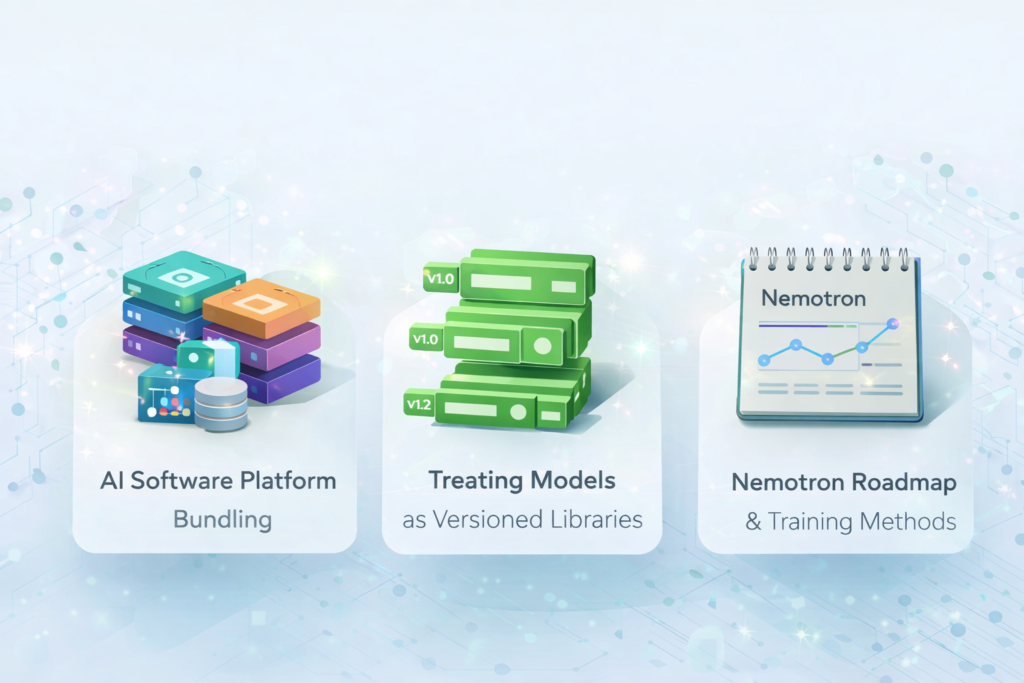
It makes its software platform more appealing by bundling the libraries, RL environments, and data needed to customize those models.
Also, it aligns Nvidia even more closely with the open-source AI community, which now drives much of the innovation in tools and agents.
But will that be enough to keep Nvidia ahead as the AI data center market explodes? In the near term, I believe the answer is yes.
Nemotron 3 raises the bar for what “open” and “enterprise-ready” look like in model land, and it does so in a way that plays to Nvidia’s strengths.
Over the longer term, its real impact may be cultural rather than technical.
By following the Nemotron roadmap, sharing its training methods, and treating models as versioned libraries, Nvidia is setting the standard for building serious AI software.
For customers choosing where to invest billions in AI infrastructure, this approach is just as important as raw TOPS.