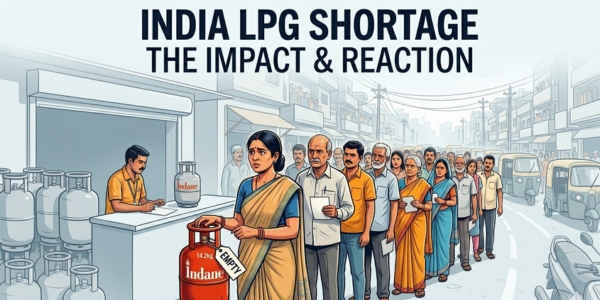
Something serious is happening with India’s LPG cylinder shortage 2026 & supply.
The government has taken an emergency step. And if you use LPG at home, this news directly affects you.
Here is everything explained in simple words.
West Asia Conflict and India’s Energy Crisis — How Are They Connected?
A war is going on in West Asia right now.
And because of that war, a key sea route called the Strait of Hormuz has been disrupted.
This is a big problem for India.
Before this conflict, more than 40% of India’s crude oil and nearly 90% of its LPG came through that very route.
Now that route is blocked. And India is feeling the pressure.
How Dependent Is India on Crude Oil Imports?
The numbers tell the real story:
- India imports about 88% of its crude oil from other countries
- Around 50% of natural gas comes from imports
- Between 60% to 90% of LPG is also imported
- India buys crude oil from nearly 40 countries — including Russia, Venezuela, and the USA
- Natural gas comes from the US, Australia, Norway, and Russia
When global supply gets disrupted, India feels it almost immediately.
India Invokes Essential Commodities Act — What Does That Mean?
On March 18, 2026, the Indian government did something it rarely does.
It invoked Section 3 of the Essential Commodities Act — a powerful law that gives the government direct control over how essential goods are produced, stored, and distributed.
Under this law, the government can:
- Fix prices of essential goods
- Set limits on how much stock companies can hold
- Stop hoarding and black marketing of fuel
- Force companies to share their data with the government
This law was last famously used during major national emergencies. Using it now shows just how seriously the government is taking this energy crisis.
Section 3: Essential Commodities Act Explained Simply
Many people are asking — what exactly is Section 3?
Think of it this way.
The Essential Commodities Act is like an emergency toolkit for the government. Section 3 is the most powerful tool inside that kit.
It allows the central government to step in and control the supply of any good that is critical for the country — like food, medicines, or fuel.
Right now, that power has been used specifically for oil and gas.
India’s Real-Time Oil and Gas Data Sharing Mandate — What Are Companies Required to Do?
This is the most important part of the government’s new order.
A fresh notification — called the Petroleum and Natural Gas (Furnishing of Information) Order, 2026 — has been issued.
Under this order, every company involved in the oil and gas business must now share detailed data with the government. This includes:
- Refiners and oil producers
- LNG importers
- Pipeline operators
- City gas distributors
- Fuel retailers — both government and private
The data they must share includes:
- How much fuel they have in stock
- How much they are producing and importing
- How they are transporting and distributing it
- Daily consumption numbers in some cases
And here is the key part — companies cannot hide this information by saying it is confidential. The order overrides all existing commercial privacy agreements.
The Petroleum Planning and Analysis Cell (PPAC) has been named as the official agency to collect, store, and analyse all this data.
Fuel Hoarding and Black Market India — The Government Cracks Down
Along with data sharing, the government has sent a strong warning to states.
Stop hoarding. Stop black marketing. Or face strict punishment.
Violations of orders under the Essential Commodities Act are treated as criminal offences. Penalties can include heavy fines — and even imprisonment.
The Centre has also told oil marketing companies like Indian Oil Corporation, BPCL, and HPCL to supply an extra 10% of commercial LPG to state governments.
India Energy Security — What Is the Government’s Priority Plan?
The government has not just collected data. It has also set clear priorities for who gets fuel first.
Here is how the priority system works:
- Priority 1 — LPG and CNG for homes and domestic use (up to 100% supply maintained)
- Priority 2 — Fertilizers (70% of normal supply)
- Priority 3 and 4 — Other industrial users (around 80%)
- Low priority — Petrochemical industries (supply being cut)
GAIL has been tasked with managing gas distribution so that homes and high-priority industries face the least disruption.
India LPG to PNG Shift 2026 — The Long-Term Solution
The government is not just managing the crisis. It is also pushing a long-term fix.
States are being encouraged to expand piped natural gas (PNG) connections to homes.
PNG is more stable than LPG cylinders. It does not depend on the same global supply chain.
The Centre has already offered a 20% subsidy to states expanding their PNG networks.
This shift from LPG cylinders to piped gas is part of a bigger plan to reduce India’s dependency on imported fuel over time.
Strait of Hormuz and India Oil Supply — What Happens Next?
Officials are watching the Strait of Hormuz situation very carefully.
India is also working to bring in more LPG from the United States to reduce its dependence on the West Asia route.
The Ministry of Petroleum’s Joint Secretary has been holding daily press briefings to reassure the public. Officials say panic booking of LPG cylinders has come down — but the situation still needs careful monitoring.
What Should You Do as a Common Person?
A few simple things to keep in mind:
- Do not panic book LPG cylinders — it makes the shortage worse
- Avoid hoarding fuel at home — it is now a punishable offence
- Check if your area offers PNG connections — it is a more stable long-term option
- Stay updated through official government briefings for accurate information
Final Thoughts
India is facing a real energy challenge in 2026.
The West Asia conflict has exposed just how dependent the country is on crude oil imports. The government has moved fast—invoking the Essential Commodities Act, mandating data sharing, cracking down on hoarding, and pushing the LPG to PNG shift.
The priority now is clear — protect the common household first.
For now, the system is holding. But the situation remains one to watch closely.